
Editorial Picks
7 Late-Night Street Food Picks in Myeongdong — 2026 Editor's Portrait
Seven cart-served picks along central Seoul's most-photographed night market, mapped by atmosphere and category — not by station order.
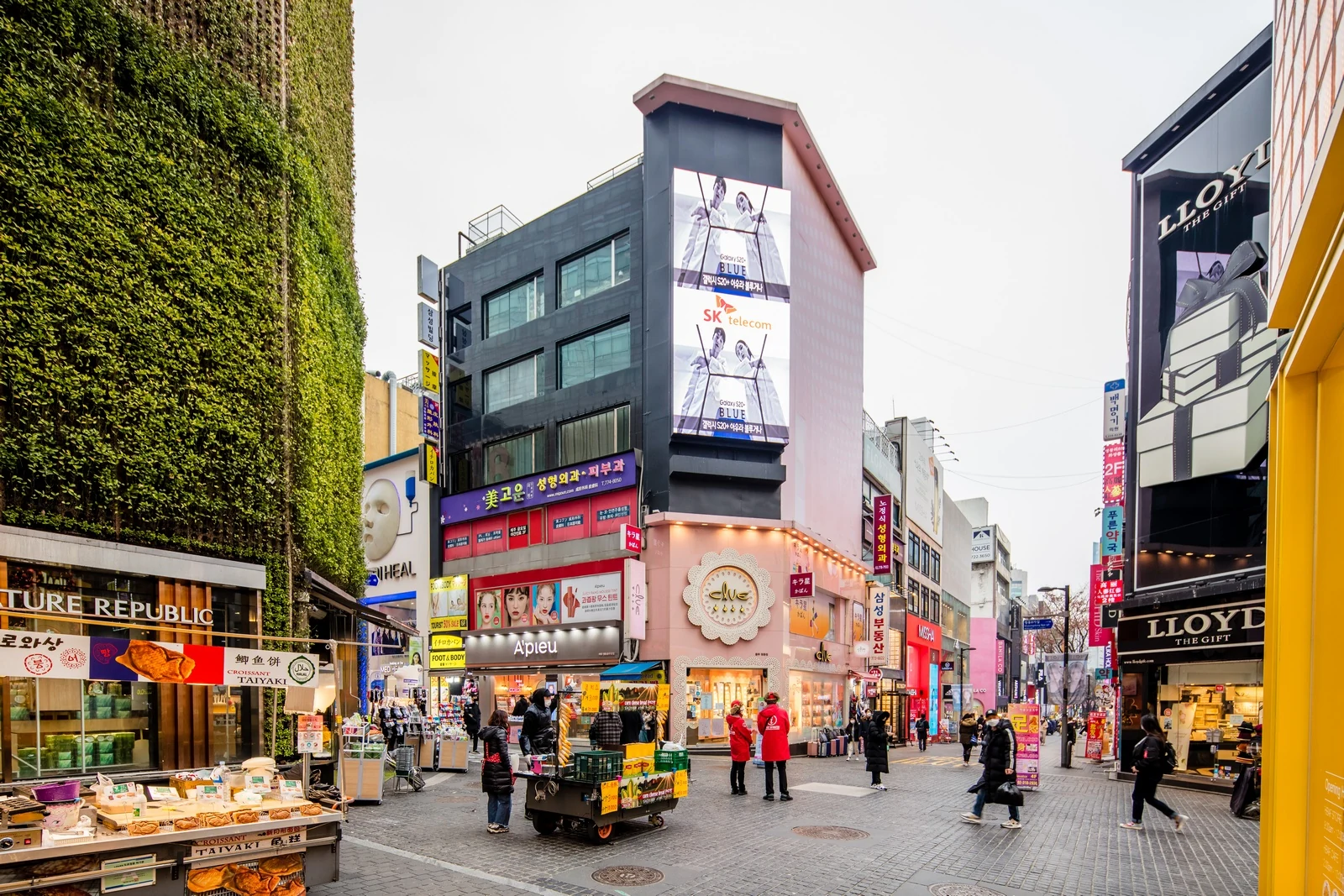
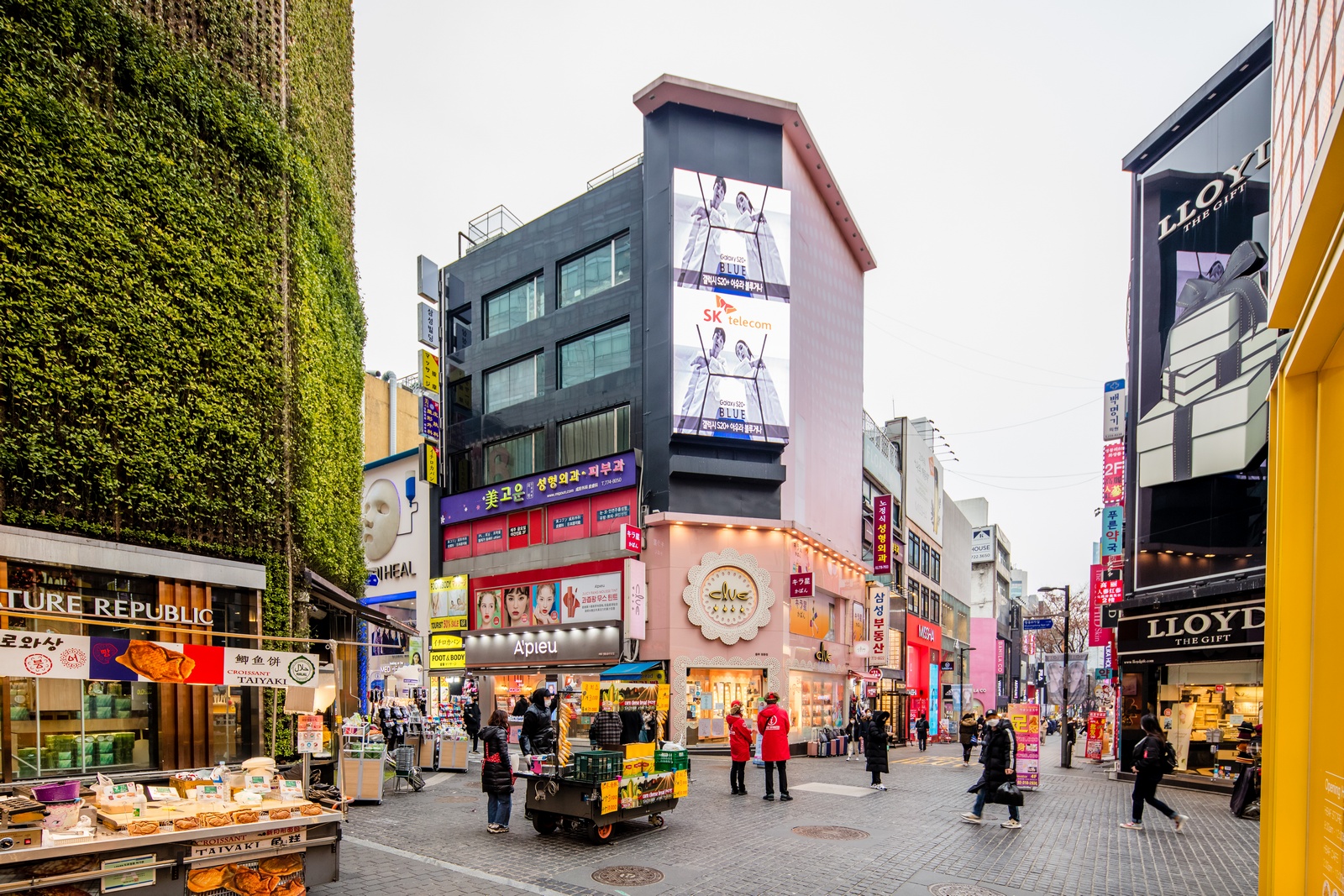
Myeongdong's night market reads, after 18:00, like a small editorial spread laid out under street lamps — the carts pull into formation around four in the afternoon, the lights come up by six, and by seven the corridor between Myeongdong Station Exit 6 and Myeongdong Cathedral has become the single most concentrated night-food stretch in central Seoul. The light is warm. The smoke rises in measured plumes. The signage hand-lettered in three languages catches the cosmetics-tower glow from across the avenue. This editorial is not a station-out walk; it is a portrait of seven cart categories that, taken together, give a visitor the editorial reading of what central Seoul's night-market hour is actually built from. Seven dishes — three savoury hand-helds, one chilli-anchored stall format, two sweet warmers, one photographable splurge — define what we are calling, in this editorial, the Myeongdong night-market portrait. Read Featured A through Featured G as category portraits rather than as a walking sequence. Pricing is modest across most of the seven — between ₩2,000 and ₩6,000 anchors the median — with one premium outlier near the Cathedral that runs ₩15,000 to ₩25,000. Cash is welcomed at every cart; the larger operators now accept card and selected mobile-pay routes. English, Mandarin and Japanese picture menus are universal across the seven categories. The night-market pulse peaks between 19:00 and 22:00, settles after 22:30, and clears for the morning by midnight.
How we mapped these seven night-market categories around Myeongdong
Our editorial method for selecting the seven Featured Myeongdong night-market categories runs on three observable criteria and two soft filters. First, each entry had to be cart-served — prepared at an outdoor stall, served in a paper sleeve or on a skewer, intended to be eaten standing or walking rather than seated at a destination restaurant. Second, each Featured category had to be widely documented across at least two of the standard travel-press primary sources — visit-seoul, visit-korea, Time Out Seoul, CNN Travel or the Michelin Guide's Seoul destination pages — so that a reader can cross-check the category against published references before walking the corridor. Third, each Featured category had to be reliably present along the Myeongdong-gil and Myeongdong 8-gil corridor across multiple vendors rather than as a single-operator cult item — the editorial value sits in the categorical density of the corridor, not in cart-chasing a specific stall. The two soft filters were foreign-visitor accessibility and visual editorial register. The seven Featured categories all maintain picture menus with English item names; all photograph reliably under cart lighting; none require the visitor to negotiate ingredient lists or seating arrangements that the night-market format does not natively support. Pricing is the working-corridor median, not a single-cart figure, and reflects the per-serving range across multiple operators trading the same category. The list holds at seven because seven is the editorial reading of the corridor's distinct categories — an eighth entry would either repeat a register or step outside the cart-served frame.
- Cart-served, prepared and finished at an outdoor stall
- Documented across two or more travel-press primary sources
- Reliably present along Myeongdong-gil or Myeongdong 8-gil
- Picture menu with English item name available
- Photographable under cart lighting without staged setup
Seven night-market category portraits along the Myeongdong corridor
The seven Featured entries below are presented as category portraits rather than as a walking sequence — the corridor reads, editorially, as a constellation of cart categories rather than as a linear route, and a visitor moving through the night market between 18:30 and 22:30 will encounter them in roughly the order their appetite dictates rather than in any geographically-fixed sequence. Read the H3s as editorial-register categories — three savoury hand-helds first, then the chilli-anchored stall, two sweet warmers, the seasonal closer and the photographable splurge. Hours reflect each category's reliable trading window across multiple operators. Same-day confirmation via Naver Map is the editorial workflow only for the seasonal and premium entries; the savoury and sweet anchors trade reliably across the entire night-market window.
Featured A — Tornado potato, the spiral on a skewer
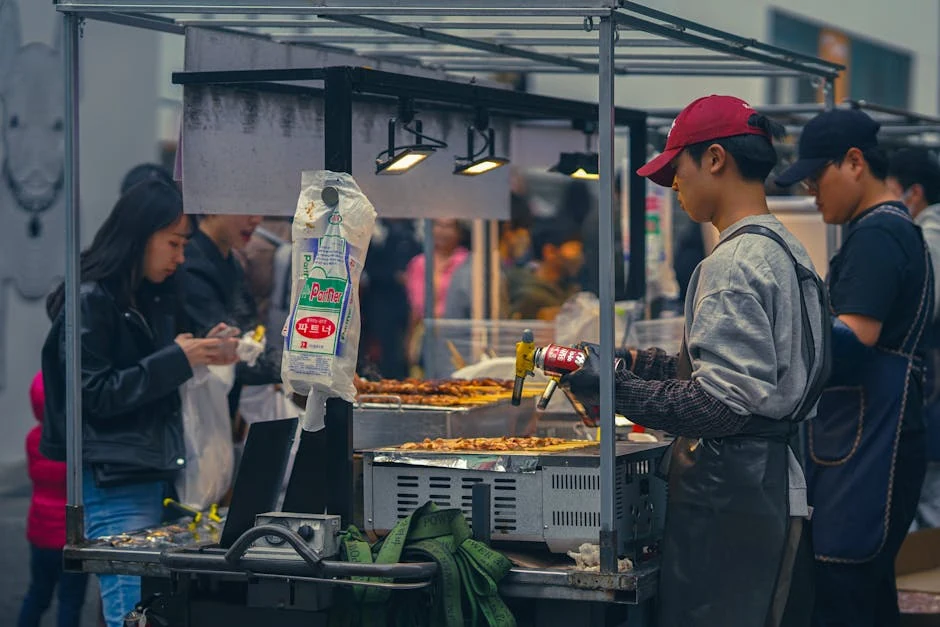
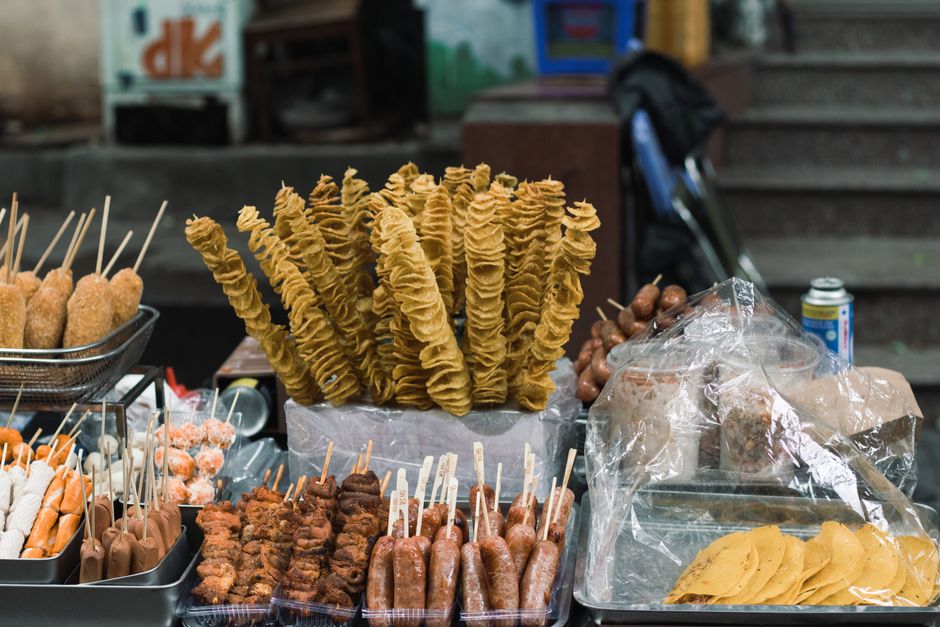
Tornado potato — hoedori gamja, the spiral-cut whole potato deep-fried on a wooden skewer and seasoned at the counter — is the corridor's most photographed savoury hand-held, and the entry that most consistently reads as the night-market portrait's opening image. The preparation is editorially theatrical. A whole potato is mounted on the cart's vertical lathe, a single curved blade cuts a continuous spiral the length of the potato, the spiral is stretched onto a long bamboo skewer, the assembly drops into hot oil for roughly three minutes and emerges as a crisp, golden, accordion-shaped object that the vendor seasons from a counter rack of approximately a dozen powders — barbecue, cheese, honey-butter, garlic, sweet-and-spicy. The cheese-powder version is the most photographed; the honey-butter version is, in editorial reading, the more interesting flavour register. Pricing sits consistently at ₩4,000 to ₩5,000, and the carts cluster along the central section of Myeongdong-gil between the cosmetics flagships. Hours run from approximately 14:00 through 23:00 daily, peak after 18:00. Picture menus are universal, cash and card accepted at most carts. The category is documented across Time Out Seoul, visit-seoul and CNN Travel as one of the most consistently-cited central Seoul street snacks. Editorial register: order the honey-butter version, hold the skewer at a slight downward tilt for the first photograph, and treat the dish as the corridor's opening hand-held before the spice and sweet registers that follow.
Featured B — Egg bread, the warm pocket for cold evenings
Egg bread — gyeranppang, an oval roll of mildly sweet batter baked to order from individual cast-iron molds with a whole egg cracked into the top and finished in the heat — is the corridor's gentlest savoury entry, and the dish that most reliably opens a cold-weather Myeongdong walk. The proposition is sweet-savoury, soft and warming, with a barely-set topping egg whose yolk retains a slight gloss and a white that has just turned firm. Carts serve three or four pieces to an order in a paper sleeve. The bread is at peak in the first ninety seconds after it leaves the mold; the editorial workflow is to eat the first piece standing at the cart while the second cools to its working temperature. The seasonal calibration is part of the dish's register: gyeranppang is technically a year-round item, but the cart's heat against the cold air gives the dish its psychological weight between November and March, when the corridor's winter pulse is at its editorial best. Most vendors offer a plain version and a cheese version; the editorial recommendation is plain first, cheese only if the appetite genuinely extends. Pricing sits consistently at ₩2,000 to ₩3,000 per piece, with carts trading along both Myeongdong-gil and Myeongdong 8-gil from approximately 16:00 through 23:00. Picture menus are standard. Documentation runs across visit-seoul and Time Out Seoul as one of the corridor's anchor categories. Editorial register: this is the corridor's working winter opener — the warm pocket that resets the body's temperature before the chilli and sweet registers.
Featured C — Tteokbokki, the chilli-anchored stall
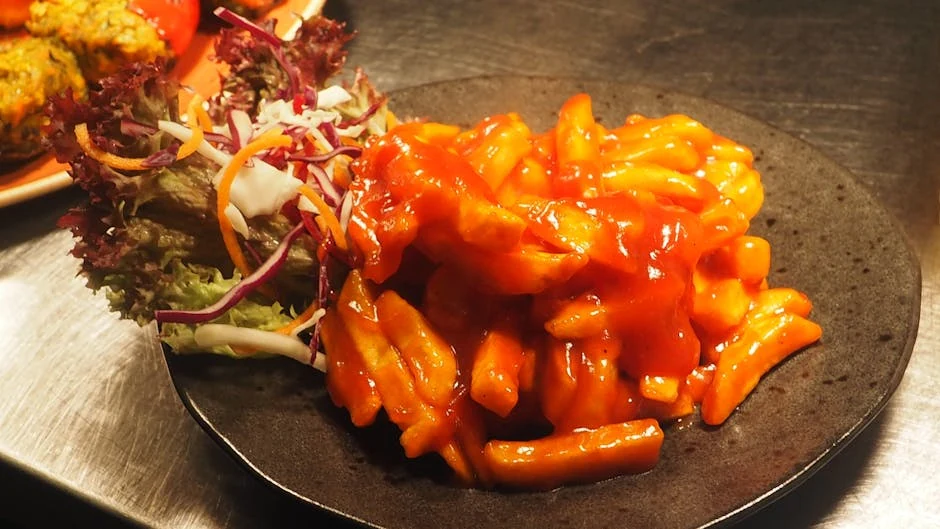
Tteokbokki — cylindrical rice cakes simmered in a sauce of gochujang, gochugaru, sugar and a measure of stock, served from a wide open griddle that holds the dish near boil — is the corridor's signature chilli-anchored stall format, and the one entry that asks the visitor to bring a clear sense of their own spice tolerance to the cart. The dish is, by default, spicy. Not the throat-grasping heat of dedicated chilli specialists, but a steady, sweet, garlicky register that builds across a serving and continues to develop for several minutes afterward. Most Myeongdong vendors pair the rice cake with eomuk (fishcake sheet in clear broth) and twigim (assorted fried items — sweet potato, glass noodle, dumpling — dipped into the tteokbokki sauce), and the trio constitutes the corridor's canonical chilli-stall order. The portions are generous; a single serving comfortably feeds two, and the carts provide small paper cups for the eomuk broth on the side. Pricing sits consistently at ₩3,000 to ₩6,000 for the rice-cake portion, with eomuk and twigim each adding ₩1,000 to ₩3,000 to the working order. Hours run from 16:00 through 23:00 across operators. Picture menus are standard with English item names. The category is universally documented — visit-seoul, the Michelin destination pages for Seoul and Time Out Seoul all reference tteokbokki as the central Korean street-food anchor — and it is the dish that, in editorial fact, reads as the corridor's most clearly Korean entry, the one a visitor cannot have ordered in equivalent form before crossing into Seoul. The eomuk broth alongside, salted and faintly anchovy-tinged, is the corridor's gentlest companion for a first-time visitor still acclimating to gochujang heat. Editorial register: order a small portion first, gauge the chilli register, and only then escalate to the full trio.
Featured D — Hotteok, the brown sugar pocket
Hotteok — a pan-fried sweet pancake stuffed with brown sugar, chopped peanuts, sunflower seeds and a measure of cinnamon — is the corridor's most clearly winter category, and the entry that anchors any cold-weather Myeongdong itinerary. The preparation reads as a small piece of corridor theatre. A ball of leavened dough is flattened on a hot, lightly oiled griddle, a spoonful of the brown-sugar-and-seed filling is enclosed at the centre, the pancake is pressed with a vented flat-iron until the sugar melts and the edges crisp, and the vendor lifts the assembly with tongs, snips one corner with kitchen scissors so the visitor can pour out the molten filling slowly rather than scorch their mouth on contact, slides it into a folded paper sleeve, hands it across. The first bite is the best one, taken at a slight angle from the snipped corner. The filling is hot enough to demand respect — the corridor has watched more than one visitor mismanage the first bite — but the heat is also the point, and the contrast between the cool winter air and the molten interior is the small drama the dish exists for. Pricing sits at ₩2,000 to ₩4,000 across operators. Carts trade most reliably between 16:00 and 22:30. Cash is preferred, with some larger carts now accepting card. The category is universally documented — CNN Travel, visit-seoul, the Korea Tourism Organization — and it is the Myeongdong street item that most reliably appears on global lists of essential Korean street food. Editorial register: hotteok is the corridor's mid-walk sweet warmer — the dish that resets the spice register after the chilli-anchored stall and prepares the palate for the seasonal closer.
Featured E — Cheese lobster, the photographed splurge
Cheese lobster — half a Boston lobster split lengthways, butterflied, finished on the open griddle under a thick blanket of melted mozzarella, seasoned with garlic butter and chopped scallion — is the corridor's photographable splurge category, and the entry that breaks the modest pricing register of every other Featured stall on this list. The dish is, in raw culinary terms, a competent piece of cart cooking — the lobster is grilled until just opaque, the cheese browned to a soft caramel under the cart's small salamander, the assembly finished with garlic butter and a generous sprinkle of green — and it is, in commercial terms, the cart that holds the longest queue along the busier section of Myeongdong-gil after dark. The price is the editorial consideration: ₩15,000 to ₩25,000 per half-lobster, a registered splurge against the corridor's ₩2,000 to ₩6,000 median. The cart holds a steady line between 17:00 and 22:30, and the wait on a busy evening runs ten to fifteen minutes. Operators maintain picture menus and accept English and Mandarin orders; staff are accustomed to the photographic ritual the dish exists for and will hold the assembly briefly under the cart's lights for a clean shot before passing it across. The cheese-lobster pairing is, on a 2026 reading, unique to the Myeongdong night market at this scale — the dish does not execute equivalently in any other Korean street-food district — and it functions, editorially, as the corridor's photographed centrepiece. Documentation runs across Time Out Seoul and visit-seoul. Editorial register: this is the splurge to order once per Myeongdong evening, photograph carefully, and treat as the corridor's photographable closing image.
Featured F — Bungeoppang & gungmulppang, the seasonal closer
Bungeoppang — fish-shaped sweet pancake with a red-bean or custard filling — and its slightly older cousin gungmulppang, the chrysanthemum-shaped variant, are the corridor's most seasonal entries and the editorial closing image of any cold-weather Myeongdong evening. The carts are primarily a cold-weather phenomenon. They appear along the corridor around late October as the temperature drops, hold their positions through early March, and disappear with the spring — in the warmer months one can find them only at the most determined vendors near Myeongdong Station and the corridor's southern stretch. The preparation reads closer to a baked-goods operation than to a hot griddle: a leavened wheat-and-rice batter is poured into individual fish-shaped molds on a rotating iron, a spoonful of red bean paste or custard is enclosed at the centre, the assembly is closed and held over heat for several minutes until the bread is golden and the filling is hot through. The fish shape is the older and more traditional; the chrysanthemum is the rounder, slightly fancier variant. Pricing is among the corridor's most modest — ₩1,000 to ₩2,000 per piece — and the carts are reliably cash-only. The dish trades between 15:00 and 22:00 in the colder months, with older vendors closing as soon as the batter runs out. The format is portable; a visitor walks with the bag, taking pieces from the top as the corridor unwinds toward the Cathedral. Documentation runs across visit-korea and visit-seoul as the seasonal Korean winter category. Editorial register: bungeoppang is the corridor's natural closing image — the pocket-warmer the visitor walks with on the slow return through the cosmetics lights to the hotel.
Featured G — Myeongdong Night Market opening stretch
The Myeongdong Night Market opening stretch — the corridor between Myeongdong Station Exit 6 and Myeongdong Cathedral where the corridor's cart-clusters are at their densest — is, in editorial terms, less a single dish than the night-market environment that frames every other Featured entry on this list. The carts here gather along Myeongdong-gil and Myeongdong 8-gil from approximately 16:00 through 23:00, with peak pulse after 18:00. The concentration is, on a 2026 reading, the largest of any central Seoul night-food district, and for a first-time visitor it is the editorially correct place to begin a Myeongdong night-market evening. The pulse is approachable. Most carts hand-letter their prices in English, accept either cash or card, and maintain picture menus with the dish name in English, Mandarin and Japanese. The first stretch — about a hundred and fifty metres north from Exit 6 — gathers a representative mix of all six Featured categories above, and a slow ten-minute walk through it gives the visitor a working sense of which carts appeal before any committed ordering. The atmosphere is warmer than the brightly-lit shopping arcades that flank it: the carts cluster, the smoke rises, the lights pool. Address: Myeongdong-gil, Jung-gu, Seoul, in the corridor between Myeongdong Station Exit 6 and Myeongdong Cathedral. Hours: approximately 16:00 through 23:00 daily, peak after 18:00. Per-item pricing across the stretch: ₩2,000 to ₩10,000, with the cheese-lobster outlier at ₩15,000 to ₩25,000. Foreigner support: English, Mandarin and Japanese menu cards at most carts. Documented across visit-seoul, Time Out Seoul and the Korea Tourism Organization. Editorial register: this is the environment in which the other six Featured categories actually live — the opening stretch is the editorial frame, not a separate dish.
Seven Myeongdong night-market picks — quick reference table
The reference table below collapses the seven Featured entries into a single planning surface. Category reflects the editorial register of each entry. Pricing reflects the working corridor median across multiple operators trading the same dish. Hours reflect the reliable trading window across operators rather than any single cart's posted hours. Same-day confirmation via Naver Map is the standard editorial workflow only for the seasonal bungeoppang entry and the cheese-lobster splurge; the other categories trade reliably across the night-market window.
| Featured | Item | Category | Price (KRW) | Reliable hours | Season |
|---|---|---|---|---|---|
| A | Tornado potato | Savoury hand-held | ₩4,000 - ₩5,000 | 14:00 - 23:00 | Year-round |
| B | Egg bread (gyeranppang) | Savoury warmer | ₩2,000 - ₩3,000 | 16:00 - 23:00 | Year-round, winter best |
| C | Tteokbokki + eomuk + twigim | Chilli-anchored stall | ₩3,000 - ₩6,000 | 16:00 - 23:00 | Year-round |
| D | Hotteok (brown sugar pocket) | Sweet warmer | ₩2,000 - ₩4,000 | 16:00 - 22:30 | Year-round, winter best |
| E | Cheese lobster | Photographable splurge | ₩15,000 - ₩25,000 | 17:00 - 22:30 | Year-round |
| F | Bungeoppang & gungmulppang | Seasonal closer | ₩1,000 - ₩2,000 | 15:00 - 22:00 | October - March |
| G | Myeongdong Night Market stretch | Cart corridor environment | ₩2,000 - ₩10,000 | 16:00 - 23:00 | Year-round |
How to plan a single-evening Myeongdong night-market walk
A single-evening Myeongdong night-market walk is the editorially natural reading of this list, because the seven Featured categories spread across complementary registers — savoury hand-held, savoury warmer, chilli-anchored, sweet warmer, splurge, seasonal closer, environment — rather than competing inside one. The editorial recommendation is to arrive at the corridor between 18:30 and 19:00, when the carts are at full pulse but before the peak-density 20:00 to 21:00 window when the corridor's queues consolidate. Open with the savoury register: tornado potato first for the opening hand-held photograph, then egg bread as the warm pocket that resets body temperature on a cold evening. Move to the chilli register: a small tteokbokki portion at a central-corridor stall, paired with the eomuk broth on the side, gauges the spice tolerance. Hotteok is the corridor's natural mid-walk sweet — the dish that resets the spice register and prepares the body for the second half of the evening. The cheese lobster is the editorial splurge, ordered once per visit, ideally between 19:30 and 20:30 when the cart's queue is at its working pace rather than its peak. The bungeoppang seasonal closer is the corridor's natural exit image — the bag the visitor walks with on the slow return through the cosmetics-tower lights toward the hotel or onward to a Myeongdong-area theatre curtain. The seventh Featured entry — the night-market opening stretch — is the frame, not a separate stop; the corridor's environment is what the other six categories are read against. The full editorial walk runs approximately ninety minutes from first cart to last bite.
- 18:30 — Open with tornado potato on Myeongdong-gil, honey-butter seasoning
- 18:45 — Egg bread, plain version, eaten standing at the cart
- 19:00 — Small tteokbokki portion with eomuk broth on the side
- 19:30 — Hotteok mid-walk sweet warmer, snipped corner first
- 20:00 — Cheese lobster splurge, photographed under cart lighting
- 20:30 — Bungeoppang seasonal closer, walked back through the corridor
What to know about cash, queue and corridor etiquette at the Myeongdong night market
Cash, queue and corridor etiquette at the Myeongdong night market reward a small set of editorial habits the standard guidebook tends to skip. First, cash remains the universal anchor across all seven Featured categories, with the smaller savoury and sweet operators still preferring physical Korean won over card or mobile-pay routes. The editorial workflow is to draw ₩30,000 to ₩50,000 in small-denomination notes before the corridor walk — ₩1,000 and ₩5,000 notes work better than ₩10,000 notes at the bungeoppang and egg-bread carts. Second, card and mobile-pay acceptance has been expanding across the larger carts on central Myeongdong-gil since approximately 2022 — the tornado-potato stalls and cheese-lobster operators routinely accept both Korean and international card networks, with Alipay support at the most foreigner-trafficked carts — but the routine is to ask before ordering. Third, queue etiquette across the corridor sits in the patient single-file register that central Seoul retail operates on generally; the cheese-lobster cart's queue is the corridor's most visible and runs ten to fifteen minutes on a busy evening, but every other Featured cart on this list serves to order within three to five minutes once the visitor reaches the counter. Fourth, photography is universally accepted across the seven Featured cart categories — operators are accustomed to the photographic ritual of the night-market evening — but the editorial register is to ask with a quiet nod before raising the camera, particularly at the smaller bungeoppang and egg-bread operators. Fifth, the corridor's eating spaces are minimal: most carts maintain a small standing counter at the side, with the broader expectation that the visitor will eat while walking. Sixth, the corridor cleans up after itself — the night-market operators maintain trash collection at intervals along Myeongdong-gil — and the editorial respect appropriate to a Beauty Pulse Magazine reader is to place wrappers and skewers in the cart-adjacent bin rather than the storefront waste containers along the avenue. The visit-korea and visit-seoul portals both maintain ongoing references for the Myeongdong night-market routine; we recommend cross-checking the current trading hours before each trip, particularly around the traditional Korean holidays when the corridor occasionally compresses.
Closing field notes from the Myeongdong night market
Closing field notes for a Beauty Pulse Magazine Myeongdong night-market editorial cluster around three observations a returning visitor will not find in standard travel listings. First, the corridor operates as a working unit rather than as a museum strip — the seven Featured categories rotate seasonal additions, weather adjustments and cart positions on cycles that synchronise loosely across the night-market hour, and a returning visitor who has not walked the corridor in twelve months will find roughly a quarter of the cart positions fresh while the seven category-anchors remain stable. Second, the editorial value of the corridor is its categorical density rather than any single cart. A first-time Myeongdong visitor reading the night-market against the cosmetics-strip editorial that flanks it will find the corridor's seven categories deliver, in ninety minutes of working appetite, the broadest sweep of Korean street-food register available in central Seoul — a sweep no single restaurant or food court can replicate by format. Third, the seven Featured cart categories are working night-market operations, not theme stalls. The tornado-potato lathe, the egg-bread mold, the tteokbokki griddle, the hotteok flat-iron, the cheese-lobster salamander and the bungeoppang mold — working pieces of street-food equipment operated by serious cart professionals, several across multiple generations of family operation. The editorial respect appropriate to a Beauty Pulse Magazine reader is to order deliberately, eat carefully, photograph quietly, and leave the cart-side as it was found. What an editorial can do is map the corridor honestly for a visitor staying on the cosmetics avenue who is ready, after the K-beauty walk, to step three blocks into the cart lights and read the night-market portrait as it actually is.
Frequently asked questions
How many street food categories are featured in this Myeongdong editorial?
Seven night-market categories are featured in this Myeongdong editorial, presented as Featured A through Featured G grouped by editorial register — three savoury hand-helds, one chilli-anchored stall format, two sweet warmers, one seasonal closer and the cart-corridor environment that frames the other six. Pricing across the seven sits between ₩1,000 and ₩25,000, with a ₩2,000 to ₩6,000 working median across the savoury and sweet anchors.
Where is the Myeongdong night market located in central Seoul?
The Myeongdong night market clusters along Myeongdong-gil and Myeongdong 8-gil in Jung-gu, central Seoul — primarily the corridor between Myeongdong Station Exit 6 and Myeongdong Cathedral. The cart cluster operates approximately 16:00 through 23:00 daily, with peak pulse after 18:00. Address registration: Myeongdong-gil, Jung-gu, Seoul. The night-market is referenced across visit-seoul, Time Out Seoul and the Korea Tourism Organization English portal.
What is the price range at Myeongdong street food carts?
Per-item pricing at Myeongdong night-market carts runs from ₩1,000 to ₩2,000 for bungeoppang fish-shaped sweet pancakes, ₩2,000 to ₩4,000 for hotteok and egg bread, ₩3,000 to ₩6,000 for tteokbokki rice cakes, ₩4,000 to ₩5,000 for tornado potato, and ₩15,000 to ₩25,000 for the cheese lobster splurge near Myeongdong Cathedral. The corridor's working median sits between ₩2,000 and ₩6,000 per item.
What time does the Myeongdong night market start?
The Myeongdong night market opens at approximately 16:00 daily, with carts setting up along Myeongdong-gil and Myeongdong 8-gil through the late afternoon. The corridor reaches peak pulse after 18:00 once the cosmetics-tower lights come up across the avenue, and trades reliably through 22:30 to 23:00 before clearing for the morning. The seasonal bungeoppang carts open earlier — around 15:00 — and close as soon as the batter runs out.
What is tornado potato and where can I find it in Myeongdong?
Tornado potato (hoedori gamja) is a spiral-cut whole potato deep-fried on a wooden skewer and seasoned at the counter from approximately a dozen powders — barbecue, cheese, honey-butter, garlic, sweet-and-spicy. Carts cluster along the central section of Myeongdong-gil between the cosmetics flagships, trade from 14:00 through 23:00, and price the dish at ₩4,000 to ₩5,000. Documentation runs across Time Out Seoul, visit-seoul and CNN Travel.
Do Myeongdong street food carts accept credit cards?
Card and mobile-pay acceptance has been expanding across the larger Myeongdong night-market carts since approximately 2022, particularly at the tornado-potato, tteokbokki and cheese-lobster operators along the central Myeongdong-gil stretch — most now accept both Korean and international card networks, with Alipay support at the most foreigner-trafficked carts. The smaller savoury and sweet carts still prefer physical Korean won; the editorial workflow is to draw ₩30,000 to ₩50,000 in small-denomination notes before the corridor walk.
How spicy is Korean street tteokbokki for first-time visitors?
Myeongdong street-cart tteokbokki carries a steady, sweet, garlicky chilli register that builds across a serving and continues to develop for several minutes afterward — not the throat-grasping heat of dedicated chilli specialists, but a registered Korean spice level that asks a first-time visitor to bring a clear sense of their own tolerance. The editorial workflow is to order a small portion first, gauge the chilli, and pair the dish with the eomuk fishcake broth on the side as the corridor's gentlest cooling companion.
Is hotteok available year-round at the Myeongdong night market?
Hotteok — the brown-sugar pan-fried sweet pancake — is technically available year-round at the Myeongdong night market, with carts trading along Myeongdong-gil from 16:00 through 22:30 daily. Pricing sits at ₩2,000 to ₩4,000. The dish's psychological best falls between November and March when the cart's heat against the cold air gives the dish its editorial register, but the category trades through the warmer months at most central-corridor operators.
What is the most photographed Myeongdong street food?
The cheese lobster cart near Myeongdong Cathedral is, on a 2026 reading, the corridor's most photographed Myeongdong street food — half a Boston lobster split lengthways, butterflied, finished on the open griddle under a thick blanket of melted mozzarella and finished with garlic butter. Pricing sits at ₩15,000 to ₩25,000 per half-lobster, a registered splurge against the corridor's ₩2,000 to ₩6,000 median, and the cart holds a ten-to-fifteen-minute queue between 17:00 and 22:30.
When is bungeoppang in season in Myeongdong?
Bungeoppang — the fish-shaped sweet pancake with red-bean or custard filling — is a seasonal category at the Myeongdong night market, appearing along Myeongdong-gil and outside Myeongdong Station from approximately late October as the temperature drops, holding through early March, and disappearing with the spring. Pricing sits at ₩1,000 to ₩2,000 per piece, cash preferred. Hours run 15:00 through 22:00 in the cold months, with vendors closing as the batter runs out.
Are there English menus at Myeongdong street food carts?
Yes — picture menus with English item names are universal across the seven Featured Myeongdong night-market categories, alongside Mandarin and Japanese-language item cards at most operators. Cart staff are accustomed to international visitors and routinely handle English, Mandarin and Japanese basic ordering. The largest cart operators along central Myeongdong-gil also maintain hand-lettered English price boards and accept English-language pointing-and-counting at the counter.
How long does it take to walk the Myeongdong night market?
A complete Myeongdong night-market walk covering all seven Featured cart categories runs approximately ninety minutes at a working appetite-pace from first cart to last bite, arriving at 18:30 and finishing around 20:30. A shorter walk covering the three savoury anchors and one sweet warmer runs about forty-five minutes. The corridor itself spans roughly 350 metres between Myeongdong Station Exit 6 and Myeongdong Cathedral, walkable end-to-end in under ten minutes without stops.
Is the Myeongdong night market open on Korean holidays?
Cart trading hours at the Myeongdong night market are subject to occasional same-day adjustment for traditional Korean holidays — particularly Seollal (Lunar New Year) and Chuseok (Korean autumn harvest festival) — when several operators close or shift their trading window earlier. The corridor's larger central-Myeongdong-gil operators generally maintain reduced trading hours through these holidays. Same-day confirmation via Naver Map is the standard editorial workflow around either holiday.
What is the closest subway station to the Myeongdong night market?
Myeongdong Station on Seoul Metro Line 4 is the closest subway station to the Myeongdong night market, with Exit 6 opening directly onto the cart corridor along Myeongdong-gil. Exit 8 serves the southern end of the corridor near the Olive Young Myeongdong south flagship. Walking time from either exit to the densest cart cluster runs two to three minutes. Euljiro 1-ga Station on Line 2 is a six-minute walk from the corridor's northern end.
Can I find vegetarian options at Myeongdong night market?
Vegetarian options across the seven Featured Myeongdong night-market categories include hotteok (brown-sugar pan-fried sweet pancake), tornado potato in plain and most powder seasonings, egg bread (vegetarian but contains egg), bungeoppang and gungmulppang in red-bean filling, and the twigim fried items at tteokbokki stalls. The tteokbokki rice cakes themselves use fish-stock-based sauce at most carts; strict vegetarians should confirm at the counter before ordering.