Treatment Guide
Ultherapy in Myeongdong
What the microfocused-ultrasound platform does, why it fits a four-day Seoul itinerary, and how to read a clinic's quote before you book.
If you have arrived at this page, it is most likely because someone — a friend with very good skin, a clinic's English website, an Instagram post that did not quite explain itself — has mentioned Ultherapy in connection with a trip to Korea. I want to answer the question that everyone asks first, plainly: Ultherapy is a non-surgical lifting treatment that uses focused ultrasound energy, delivered through a handpiece pressed gently against the skin, to create thousands of microscopic coagulation points at three different depths beneath the surface. Those small thermal injuries, scattered carefully across the brow, the cheek, the jawline, the neck, and now the décolleté, set off the body's own remodelling response. New collagen forms over the next twelve to sixteen weeks; the skin lifts, modestly, from within. The treatment takes one session, lasts about an hour, leaves the patient with a faint pink flush that fades by dinner, and produces a result that develops slowly over three to six months. It is the rare aesthetic procedure that fits genuinely inside a holiday — a half-day at a clinic, a quiet afternoon, a flight home the next morning. Myeongdong, the central Seoul neighborhood where I write this, is one of the highest-volume Ultherapy markets in the world. The clinics here have been treating international patients with this platform for more than ten years.
How Ultherapy works at three depths
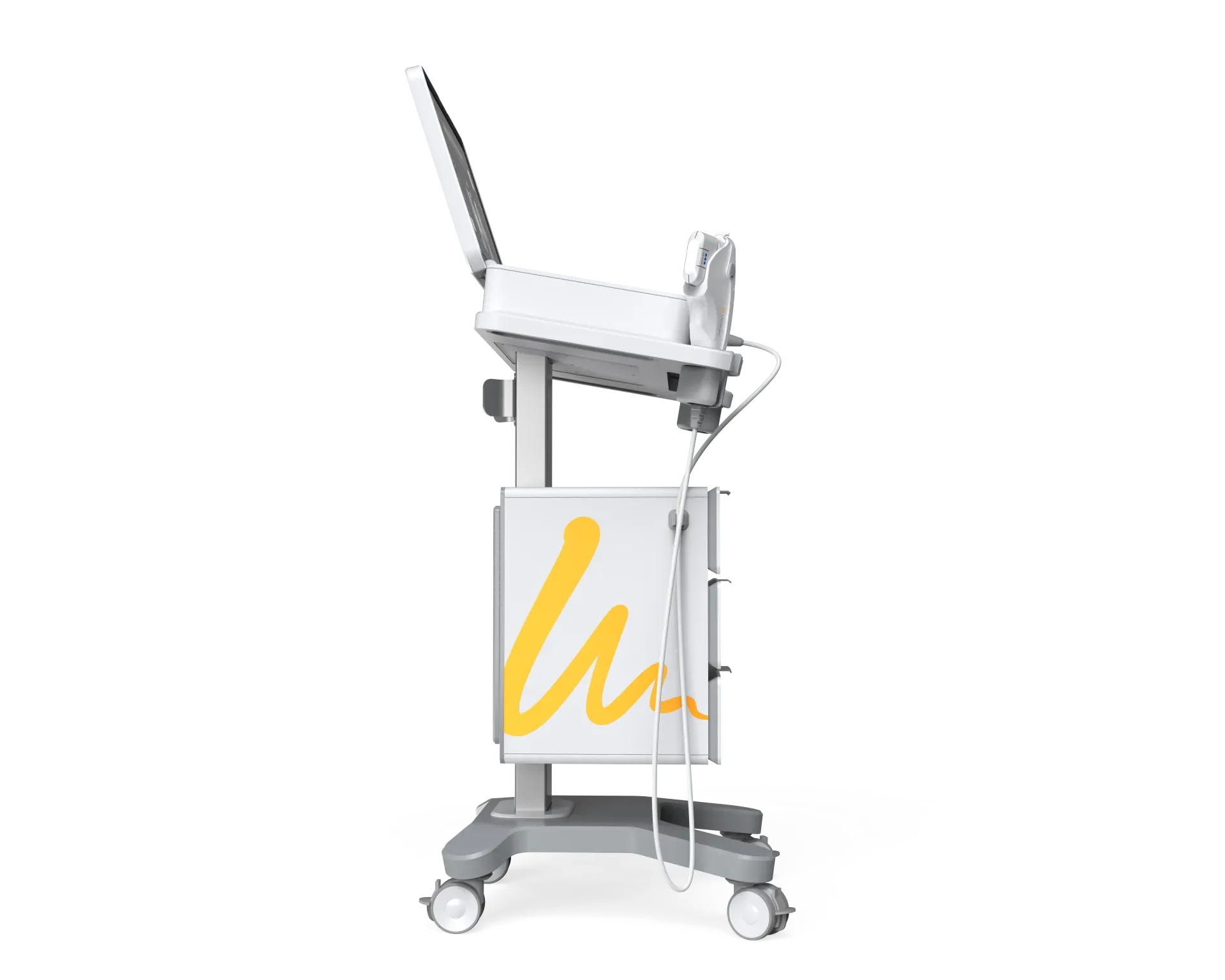
The platform delivers microfocused ultrasound energy at three controlled depths — typically 1.5 millimetres, 3.0 millimetres, and 4.5 millimetres beneath the skin's surface. Each depth corresponds to a different anatomical layer: the dermis, the subcutaneous fat layer, and the SMAS, the superficial musculo-aponeurotic system that surgeons engage during a facelift. The 4.5 millimetre depth is where the structural lift is generated; the shallower depths address skin quality and dermal contraction. Each pulse creates a tiny, precise zone of thermal coagulation — small enough that the surrounding tissue remains intact, focused enough that the body recognises the injury and begins to remodel collagen in response. The treatment does not destroy fat or move muscle. It triggers a slow biological response. That is why the result is not visible on the day. The lift you will see twelve weeks later is the new collagen your body has built. The Merz Aesthetics platform, made by the German company that manufactures the original Ultherapy and the current PRIME generation, is the one I cover here, because it is the only microfocused-ultrasound device on the Korean market with the regulatory provenance, the published clinical literature, and the international authorisation pathway that lets a Spanish-speaking traveler verify what she is being offered.
Who Ultherapy is for, and who it is not for
Ultherapy treats moderate skin laxity in patients who want a structural lift but are not yet ready for surgery. The clinical lane is fairly specific. Patients with moderate brow descent, soft jowl formation, mild submental laxity, and a face that has begun to read as tired rather than transformed — those are the patients who tend to like the result most. Patients with substantial structural sag, deep nasolabial folds, or platysmal banding will not get a surgical-equivalent result from this platform; the honest physician will tell you so before you book. Patients whose primary concern is texture, tone, pigmentation, or fine lines are also looking at the wrong tool — for those concerns, regenerative work or laser resurfacing fits better. I write this carefully because in my experience, the readers who are happiest with Ultherapy are the ones whose expectations were calibrated correctly before treatment. A pre-wedding mother in her early fifties who wants her photographs to look like her, only better-rested, is a very satisfied patient. A patient who hopes the platform will undo twenty years is a disappointed one.
Why Myeongdong fits a tourist's calendar
Myeongdong is the neighborhood between City Hall and Namsan, ten minutes' walk from Gyeongbokgung Palace and Deoksugung, fifteen minutes from Namsan Tower and the Seoul observation decks. From Incheon International Airport, it is a single Airport Railroad ride to Seoul Station and one or two metro stops to Myeongdong itself; an arriving traveler can be in her hotel within ninety minutes of clearing customs. The neighborhood's density of aesthetic clinics is the highest in central Seoul outside Gangnam, and the better Myeongdong clinics have been serving international patients — Mandarin, Japanese, English, Russian, and increasingly Spanish — since the early 2010s. For a Spanish-speaking traveler, this matters because the international-patient infrastructure has matured to the point that consultation, treatment, payment, follow-up, and aftercare can all be handled in a working language other than Korean. I cover Myeongdong specifically because it concentrates the practical advantages — transit, hotels at three price brackets, evening food options, multilingual coordinators — that turn a treatment trip into a holiday rather than a clinical errand.
What a typical day looks like
A typical Ultherapy day in Myeongdong begins with a clinic arrival around 10 or 11 in the morning. The international-patient coordinator welcomes the patient, completes the pre-treatment paperwork, and reviews the consultation notes that were exchanged before the trip. The treating physician examines the patient, photographs the face at multiple angles, and reviews the proposed shot map — the count and distribution of pulses across the treatment area. Topical anaesthesia is applied to the face and neck for thirty to forty-five minutes. The treatment itself takes between forty and seventy minutes depending on shot count and area. The patient rests for fifteen minutes afterwards, the coordinator reviews aftercare instructions in the working language, and the patient is back in the neighborhood by mid-afternoon. Most patients have dinner the same night, walk in Myeongdong the same evening, and fly home the next day or the day after. The clinic typically follows up by messenger — KakaoTalk, WhatsApp, LINE, or WeChat — for the next two weeks, answering questions and reviewing photographs the patient sends back.
What the result reads like, and how to evaluate it honestly
The honest editorial framing for Ultherapy is that the result reads as 'looking well-rested' rather than as a visibly different face. The lift is subtle; the photograph at twelve weeks shows a jawline that is a little tighter, a brow that is a little more open, a cheek that sits a little higher than it did before. Family and friends typically notice that the patient looks better without being able to identify what has changed. That is the platform's clinical signature — slow, structural, gentle. To evaluate the result honestly, photograph at baseline (before treatment) and at three months, in the same lighting, the same angle, the same expression. Side-by-side photographs are the only reliable way to see the change. Mirror impressions in the weeks after treatment are unreliable because daily exposure to one's own face dulls the eye to gradual difference. The published clinical literature suggests patient satisfaction correlates more closely with appropriate candidate selection and physician technique than with shot count or platform generation.
What to bring, and what to expect on the day
Bring a soft hair tie if your hair is long; the clinic will offer one if you forget. Wear something that pulls over the head easily so you do not catch makeup on a collar afterwards. Bring sunscreen — broad-spectrum SPF 50 or higher — for the walk back to the hotel; you will not be peeling or red, but the skin is more reactive in the first few hours. Bring your passport: Korean clinics request photographic identification before treatment, and many international-patient desks photocopy the data page for medical-record purposes. Bring the consultation correspondence you exchanged with the clinic before your trip — the email or messenger thread that confirmed the proposed shot count and price — so that the day-of conversation can reference the same numbers. And bring a companion if you can. Korean clinics generally welcome a mother, sister, friend, or partner in the consultation room, and the companion's presence often makes the post-treatment afternoon more pleasant than a solo recovery in a hotel.
How to verify the platform is authentic
Korea's Ministry of Food and Drug Safety (MFDS) regulates aesthetic devices, and the better Korean clinics will display their MFDS device approval and their Merz authorised-provider certificate openly. Before you book, ask the clinic which generation of the platform they operate — original Ultherapy, or the current Ultherapy PRIME — and whether the device is listed on the Merz Aesthetics provider locator. A clinic that cannot answer that question, or that hesitates over which generation it operates, is a clinic worth a second thought. The Korean Society of Dermatology (KSD) and the Korea Health Industry Development Institute (KHIDI) both publish information for international patients on how to verify a clinic's regulatory status; we link to both in the resources section of this site. The platform itself is identical across authorised providers — the same Merz device, the same software — but physician technique, depth selection, and shot distribution vary considerably between practices.
How this guide treats clinic recommendations
I do not name clinics in main editorial coverage. Korean medical-advertising law (Article 56 Clause 4 of the Medical Service Act) treats named comparative endorsements as a regulated category, and beyond the legal frame, I believe the more useful editorial answer for most readers is not 'which clinic is best' but 'how do I evaluate a clinic in front of me.' I want to give the reader a vocabulary — shot count, depth distribution, anaesthesia protocol, photographic documentation, multilingual coordination — that lets her ask any clinic the questions a Korean patient would ask. HEIM GLOBAL maintains relationships with several Myeongdong clinics for the patients who reach out for facilitation; those relationships are commercial and disclosed. The editorial here is independent.
Frequently asked questions
Is Ultherapy painful?
It is sensation-rich rather than uniformly painful. The 4.5 millimetre SMAS-depth shots are the most intense — patients describe a brief sharp sensation accompanied by warmth. Topical anaesthesia for thirty to forty-five minutes is standard; oral analgesia or light intravenous sedation is available for high-anxiety patients. The current PRIME generation is meaningfully more tolerable than the original DeepSEE generation.
How many shots do I need?
A face-and-neck protocol typically runs 600 to 900 shots. A more comprehensive face-neck-décolleté protocol can run 800 to 1,200 shots. The number alone is not a quality marker — distribution and depth matter as much as count. Ask the clinic to show you the proposed shot map before you book.
How long does the lift last?
The lift develops over three to six months as collagen remodelling matures and persists for twelve to eighteen months in most patients. Many international travelers schedule maintenance treatments annually; some clinics recommend a top-up at six months for patients with rapid laxity progression.
Can I fly home the day after treatment?
Yes. Most patients fly home the next morning without complication. There is no medical contraindication to air travel after Ultherapy. Some patients prefer to stay one extra day to enjoy the neighborhood without travel pressure, but it is not clinically required.
Will my face look swollen the day after?
Mild transient erythema for a few hours is common; mild localised swelling at the SMAS-depth coagulation points occasionally persists into the next day. Bruising at the submental area is uncommon but possible. The face is generally socially presentable from the moment the patient leaves the clinic.
Can my mother or sister come to the consultation?
Yes. Most clinics in Myeongdong welcome a companion in the consultation room with the patient's consent. Group consultations — mother and daughter, sisters, friends traveling together — are routine in international-patient practice.
What's the difference between Ultherapy and Ultherapy PRIME?
Ultherapy PRIME is the current generation; the original Ultherapy used the older DeepSEE imaging platform. PRIME is faster, generally better tolerated, and adds décolleté treatment. The clinical mechanism — focused-ultrasound thermal coagulation at multiple depths — is the same. We cover this in detail on a separate page.
Is the result visible immediately?
No. There is sometimes a faint immediate tightening as a result of dermal contraction, but the structural lift develops gradually over three to six months as new collagen forms. Photographs at baseline and at three months are the only reliable way to evaluate one's own result.